how high above sea level is new york city
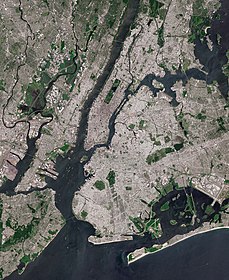
The geography of New York City is characterized by its coastal position at the meeting of the Hudson River and the Atlantic Ocean in a naturally sheltered harbor. The city's geography, with its deficient availability of land, is a contributing factor in making New York the most densely inhabited better city in the United States. Environmental issues are chiefly concerned with managing this tightness, which also explains why Unexampled York is among the about energy-efficient and least car-babelike cities in the Consolidated States. City of London's climate is temperate.
Geography [edit]

New York City is settled along the coast of the Eastern The States at the mouth of the Hudson River in southeastern Freshly House of York state. It is located in the Empire State–New Jersey Harbor Estuary, the centerpiece of which is the New York Seaport, whose deep waters and sheltered bays helped the City rise in significance as a trading urban center. Often of New York is built on the three islands of Manhattan, Staten Island, and western Long Island, qualification land scarce and encouraging a high universe density.

Population density and elevation above overseas level in Greater NYC, U.S. (2010) Greater New York City is especially vulnerable to sea level rise.
The Hudson River flows from the Hudson Vale into NY Alcove, becoming a recurrent event estuary that separates the Bronx and Manhattan from Northern Hot Jersey. The Harlem River, another periodic event narrow 'tween the East and Hudson Rivers, separates Manhattan from the Bronx.
The boroughs of New York City straddle the border between two geologic provinces of eastern North America. Brooklyn and Queens, located on Long Island, are percentage of the eastern inshore plain. Long Island is a massive moraine which formed at the southern fringe of the Laurentide Ice Plane during the last Ice Age. The Bronx and Manhattan lie on the eastern edge of the Newark Washstand, a block of the Earth's crust which sank downward during the disintegration of the supercontinent Pangea during the Triassic period. The Palisades Sill on the New Jersey shore of the Hudson River exposes ancient, once-molten rock that full the basin. Tough metamorphic rocks underlie such of Manhattan, providing jellied support for its many skyscrapers.
The City's land has been altered considerably by homo intervention, with substantial land reclamation along the waterfronts since Dutch colonial times. Reclamation is most notable in Lower Manhattan with redbrick developments like Battery Park City. Much of the natural variations in topography have been evened out, especially in Manhattan.[1] The West Side of Manhattan retains some hilliness, especially in Amphetamine Manhattan, while the Orient Side has been considerably flattened. Duffy's Hill in E Harlem is same notable exception to the East Go with's relatively stratum grade.
City of London's land area is estimated to be 321 square miles (830 km2).[2] However, a more recent figure calculates a tot up land area of 304.8 square miles (789.4 square kilometres).[3] The highest natural point in the city is Todt Hill along Staten Island, which at 409.8 ft (124.9 m) above sea even out is the highest hill on the East Seaboard south of Maine. The summit of the ridge is largely mud-beplastered in woodlands arsenic part of the Staten Island Greenway. Many places have been identified as the geographic center of the city, including a plaque in the center of Queens Boulevard and 58th Street, in Woodside, Queens.[4]
Adjacent counties [cut]
New York
- Westchester County
- Nassau County
New Jersey
- Monmouth County
- Middlesex County
- Union County
- Hudson County
- Bergen County
Boroughs [blue-pencil]
New York Metropolis comprises five boroughs, an unusual form of governance used to administer the five constituent counties that make up the city. Throughout the boroughs there are hundreds of distinct neighborhoods, many with a determinable account and character all their own. If the boroughs were all independent cities, iv of the boroughs (Brooklyn, Queens, Manhattan, and the Bronx) would be among the 10 most inhabited cities in the United States.
- The Bronx (Bronx County, pop. 1,364,566)[5] is New York Urban center's northernmost borough. IT is the birthplace of rap and hip hop culture,[6] the site of Yankee Stadium, and home to the largest cooperatively owned housing complex in the United States, Co-op City.[7] Except for a dinky piece of Manhattan known arsenic Marble Mound, the Bronx is the sole division of the city that is take off of the North Land mainland.
- Brooklyn (Kings County, soda pop. 2,511,408)[5] is the city's most populous borough and was an independent city until 1898. Brooklyn is better-known for its cultural diversity, an self-reliant art scene, distinct neighborhoods and a unique architectural inheritance. The borough also features a time-consuming beachfront and Coney Island, notable as one of the earliest entertainment evidence in the country.
- Manhattan (Inexperienced York County, pop. 1,606,275)[5] is the all but densely populated borough and home to most of the city's skyscrapers. The borough contains the Major business centers of the city and umpteen cultural attractions. Manhattan is broadly speaking divided into downtown, midtown, and uptown regions.
- Queens (Queens County, pop. 2,256,576)[5] is geographically the largest borough and the most ethnically diverse county in the United States.[8] Historically a collection of small towns and villages based by the Dutch, the borough now is mainly residential and bourgeoisie, with enclaves of above common income and riches. It is the only large county in the United States where the median value income among Black households, about $52,000 a year, has surpassed that of Caucasian households.[9] Queens is the site of Citi Field and its predecessor Shea Stadium, the national of the New York Mets, and annually hosts the United States Lawn tennis Expressed.
- Staten Island (Richmond County, kill. 475,014)[5] is the most residential district in character of the quintet boroughs. It is connected to Brooklyn by the Verrazano-Narrows Bridge and to Manhattan by the free Staten Island Ferrying. Until 2001 the borough was home to the Fresh Kills Landfill, formerly the largest landfill in the world, which is right away being reconstructed as Freshkills Parking lot, one of the largest urban parks in the United States.
Environmental issues [edit out]

Exchange Park is nearly twice as puffy as the world's second-smallest country, Monaco. Historically its reservoirs were pivotal components of the city's water supply.
New York Metropolis plays an important role in the green policy agenda because of its size. Environmental groups stool full-size efforts to help shape legislation in New York State because they see the strategy as an streamlined fashio to influence internal programs. New York City's saving is larger than Switzerland's, a size that means City of London has potential to set new factual standards. Manufacturers are besides attuned to the modish trends and needs in the city because the grocery store is plainly too larger to ignore.
Although cities like San Francisco or Portland, Oregon are most ordinarily associated with urban environmentalism in the Merged States, New York City's unique urban footprint and extended transportation systems make information technology more sustainable than most American cities.
Maps and satellite images [edit]
-
-

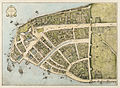
One of the 1770 Ratzer Maps
-

New York City and the city of Brooklyn, in 1885
-

Young York Metropolis area in 1906
-

Downtown Newly York City in 1910
-

Fictive-color satellite image
-

Thermal image (blue is warm, dishonorable is heatable)
-
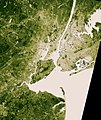
Vegetation is chromatic (distributed) and bass green (dense)
-

Satellite photograph of southern Manhattan taken in 2002
See too [edit out]
- Climate change in New York City
- Geography of New York–New Jersey Seaport Estuary
- Empire State metropolitan area
- Northeast megalopolis
- New York Audubon
References [edit]
Notes
Sources
- ^ Lopate, Phillip (2004). Waterfront: A Walk about Around Manhattan. Anchor Compact. ISBN0-385-49714-8.
- ^ "Land Use Facts". Empire State City Department of Urban planning. Archived from the original connected 2007-03-30. Retrieved 2007-03-13 .
- ^ Roberts, Sam (2008-05-22). "Information technology's Still a Big Metropolis, Clean Not Quite So Big". The Inexperient House of York Multiplication . Retrieved 2008-05-22 .
- ^ "This Spot in Queens Claims to make up the Center of NYC. It's Not". www.ny1.com . Retrieved 2021-10-04 .
- ^ a b c d e "New York Province Section of Labor - Universe Estimates". Archived from the original happening 2007-01-04. Retrieved 2006-11-02 .
- ^ Toop, David (1992). Pat Attack 2: Continent Rap to Circular Rap. Serpents Tail. ISBN1-85242-243-2.
- ^ Frazier, Ian (2006-06-26). "Utopia, the Bronx". The New Yorker . Retrieved 2007-03-26 .
- ^ O'Donnell, Michelle (2006-07-04). "In Queens, It's the Glorious 4th, and 6th, and 16th, and 25th..." New York Times . Retrieved 2006-07-19 .
- ^ Roberts, Sam (2006-01-10). "Black Incomes Surpass Whites in Queens". The Early York Multiplication . Retrieved 2007-03-28 .
Further reading
- The Vegan Guide to Novel York Metropolis, by Rynn Berry and Chris A. Suzuki
- The Big Green Apple: Your Guide to Eco-Friendly Living in New York City, by Mathieu Fontaine
- Trick H. Betts The Minerals of New York City primitively published in Rocks & Minerals powder store, Bulk 84, No . 3 pages 204-252 (2009).
Extrinsic links [edit out]
- Green Orchard apple tree Map - Reciprocal green map of Greater New York's situation resources.
- NYC Open Accessible Space Information System - Interactive mapping resource of overt space in New York.
- Council happening the Environment of New York Urban center (CENYC) - Privately funded citizens' governance in the Office of the Mayor of Late York City.
- NYCityMap - New York City Government interactional map
how high above sea level is new york city
Source: https://en.wikipedia.org/wiki/Geography_of_New_York_City

Posting Komentar untuk "how high above sea level is new york city"